
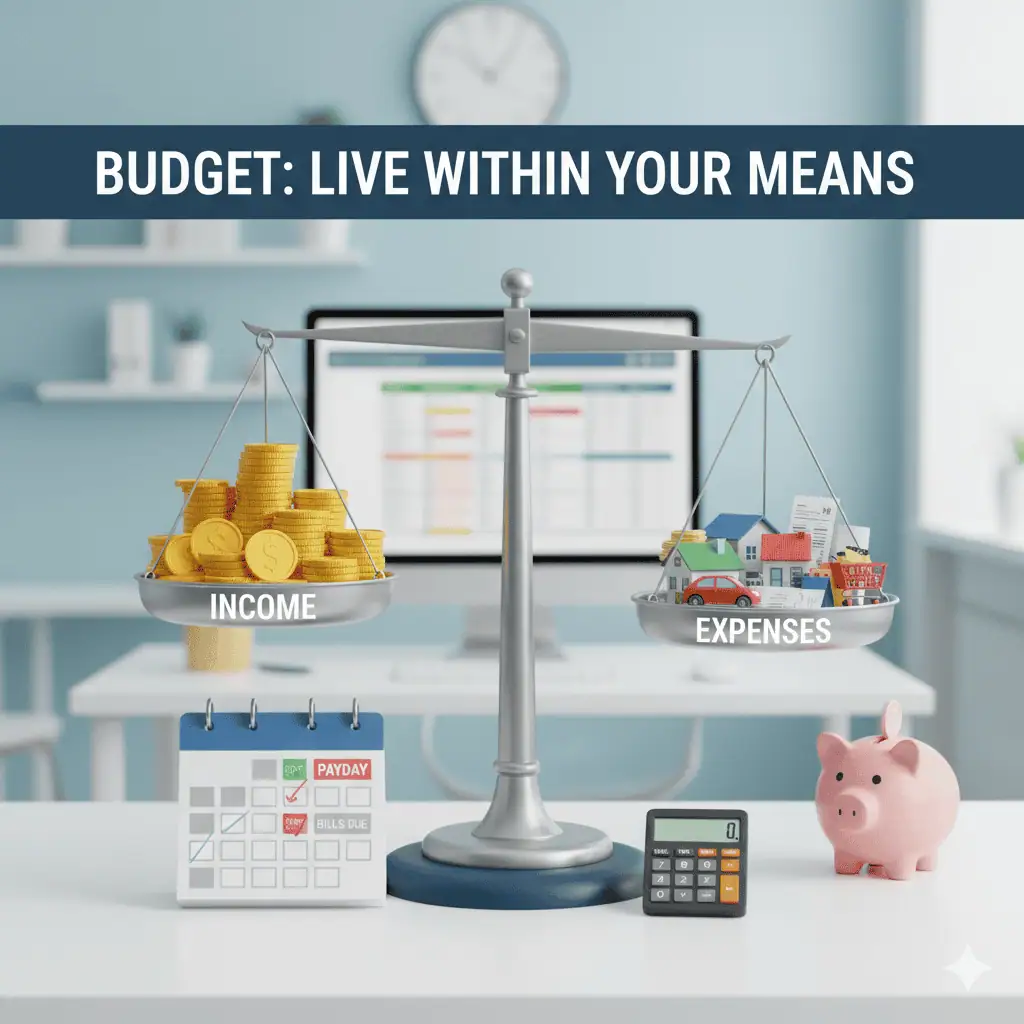
What is the definition of a budget?
A budget is a financial plan that outlines expected income and expenses over a specific period, usually monthly or yearly. It serves as a roadmap for how money will be earned, spent, and saved. A budget helps individuals, families, businesses, and governments manage resources wisely while avoiding overspending. The purpose of a budget is to balance financial inflows and outflows, ensuring sustainability. Without a budget, it’s easy to lose track of money and face financial difficulties. Simply put, a budget is about planning, controlling costs, and achieving goals such as saving, investing, or efficiently covering essential needs.
What are the 4 types of budget?
Four primary types of budgets help people and organizations manage money effectively:
- Operating Budget—Covers day-to-day expenses like rent, salaries, and utilities.
- Cash Flow Budget—Tracks money coming in and out to maintain liquidity.
- Financial Budget – Focuses on long-term assets, liabilities, and investments.
- Static Budget—A fixed plan that does not change with actual performance.
Each type serves a unique role. For instance, businesses rely on operating budgets for smooth operations, while cash flow budgets prevent shortfalls. Understanding these types enables the tailoring of financial planning to meet different needs and goals.
What is a budget example?

An example of a monthly household budget looks like this:
| Category | Planned Amount ($) | Actual ($) |
|---|---|---|
| Income | 3,000 | 3,050 |
| Rent/Mortgage | 900 | 900 |
| Groceries | 400 | 420 |
| Utilities | 200 | 210 |
| Transportation | 250 | 230 |
| Savings/Investment | 400 | 390 |
| Entertainment | 150 | 180 |
This example shows how a budget works: money is allocated in advance, then compared with actual spending. Tracking ensures financial discipline.
What’s in a budget?
A budget typically includes several key components:
- Income—salaries, business profits, or other earnings.
- Fixed Expenses—Regular costs like rent, insurance, and utilities.
- Variable Expenses – Groceries, fuel, or leisure, which can change monthly.
- Savings and Investments – Money set aside for future needs or opportunities.
- Debt Payments – Credit card, loan, or mortgage obligations.
Together, these categories form a financial snapshot. By clearly outlining income and expenses, a budget highlights where money goes and where adjustments are needed. Without these details, financial planning becomes guesswork instead of an organized strategy.
What are the 7 types of budgets?
Beyond the basic four, experts also highlight seven detailed budget types:
- Operating Budget
- Cash Flow Budget
- Financial Budget
- Static Budget
- Flexible Budget
- Capital Budget
- Master Budget
- Flexible budgets adjust based on actual performance.
- Capital budgets focus on long-term investments like equipment or infrastructure.
- Master budgets combine all other budgets into a comprehensive plan.
Together, these types give organizations and individuals powerful tools to manage different financial aspects. Choosing the right one depends on your goals—personal savings, business operations, or strategic investments.
Why is the budget important?
A budget is crucial because it provides financial control and direction. It prevents overspending, reduces debt, and builds savings. For businesses, a budget ensures steady operations and resource allocation.
For individuals, it promotes smarter money habits. Budgets also improve decision-making by forecasting needs and aligning spending with goals. Without a budget, financial uncertainty often leads to stress and unwise choices.
Governments also rely on budgets to distribute funds for healthcare, education, and infrastructure. Ultimately, the importance of a budget lies in creating financial stability, boosting confidence, and supporting both short-term necessities and long-term ambitions.
What is the function of a budget?
The primary function of a budget is to act as a financial guide. It helps in:
- Planning – Anticipating income and expenses.
- Controlling – Monitoring spending and avoiding waste.
- Coordinating – Aligning personal or business activities with available resources.
- Motivating – Encouraging individuals or employees to meet financial targets.
- Evaluating – Measuring performance against planned outcomes.
Budgets provide discipline by setting financial boundaries. For example, a company uses budgets to decide how much to spend on marketing versus operations. Without this function, resources can be mismanaged, leading to overspending or underinvestment in critical areas.
What are the four types of expenses?
Expenses are generally divided into four main types that form the basis of budgeting:
- Fixed Expenses – Regular, unchanging costs like rent, insurance, or subscriptions.
- Variable Expenses – Fluctuating costs such as groceries, fuel, and entertainment.
- Periodic Expenses – Costs that occur occasionally, like car maintenance or annual fees.
- Discretionary Expenses – Non-essential spending, such as dining out or vacations.
Understanding these categories is crucial for financial planning. For example, identifying discretionary expenses helps you cut unnecessary costs and increase savings. Classifying expenses into these four types makes budgets more realistic and manageable.
What are the four steps in preparing a budget?
Preparing a budget involves four simple but effective steps:
- Identify Income – Calculate all earnings, including salaries, side hustles, or business revenue.
- List Expenses – Track fixed, variable, and discretionary costs.
- Set Priorities – Allocate funds first to essentials like housing, food, and debt payments.
- Monitor & Adjust – Compare planned vs. actual spending and refine monthly.
For instance, if your income is $2,000, you might allocate $900 for rent, $400 for food, $300 for transportation, and $200 for savings. Following these four steps makes budgeting simple, clear, and effective, ensuring better money management.
What are the four walls?
The four walls of budgeting, introduced by financial expert Dave Ramsey, focus on securing life’s essentials before anything else:
- Food – Groceries and meals to sustain health.
- Utilities – Electricity, water, gas, and basic bills.
- Shelter – Rent or mortgage payments to ensure housing stability.
- Transportation – Costs of commuting, fuel, or vehicle maintenance.
These “walls” act as financial protection, ensuring survival and stability even during tough times. By prioritizing the four walls first, families avoid crises and maintain dignity. Once these needs are covered, any extra funds can go toward savings, debt repayment, or discretionary spending.
How to create a budget?
Creating a budget involves these steps:
- List Income Sources – Salaries, side hustles, or business profits.
- Track Expenses – Fixed (rent, loans) and variable (groceries, travel).
- Set Priorities – Allocate money for essentials before wants.
- Plan Savings – Dedicate at least 10–20% of income to savings or investments.
- Monitor and Adjust – Compare planned vs. actual spending regularly.
For example, if monthly income is $2,500, allocate $900 for rent, $400 for groceries, $300 for transport, $200 for entertainment, and $500 for savings. Regular adjustments ensure the budget stays realistic and effective.
What is a budget in one word?
If defined in one word, a budget equals “plan.” This single word captures the essence of budgeting, which is organizing resources for future needs. A budget is essentially a plan for how money flows in and out. Just as a travel plan outlines routes and stops, a financial plan outlines income and expenses.
While “control” or “discipline” could also describe a budget, “plan” is the most universal term. Whether in personal finance, business operations, or government spending, a budget is always about preparing and allocating resources wisely to meet specific financial goals and responsibilities.
What is the best budget for students?
For students, the best budget is a 50/30/20 budget tailored to their lifestyle.
- 50% Needs – Rent, food, tuition, books.
- 30% Wants – Entertainment, hobbies, outings.
- 20% Savings/Debt – Emergency fund, loan payments.
Example: A student earning $1,000 monthly allocates $500 for needs, $300 for wants, and $200 for savings or debt repayment. This method is flexible, easy to follow, and ensures financial balance. Students also benefit from using budget apps to track spending. By adopting such a structure, they learn financial responsibility early, reduce stress, and build habits that prepare them for future independence.
What are the three types of budgets?
The three key types of budgets are:
- Surplus Budget – Revenue exceeds expenses, creating savings.
- Deficit Budget – Expenses exceed revenue, requiring borrowing or cuts.
- Balanced Budget – Revenue equals expenses, with no deficit or surplus.
Governments often strive for a balanced budget to ensure stability, while individuals seek a surplus to accumulate wealth. For example, if someone earns $2,000 and spends $1,800, they have a surplus of $200. Knowing these three types helps people understand financial health, whether for households, businesses, or national economies, and make better decisions about spending and saving.
What are the qualities of a good budget?
A good budget has the following qualities:
- Realistic – Based on actual income and achievable goals.
- Flexible – Can adapt to unexpected changes.
- Comprehensive – Covers all areas: income, expenses, savings, and debts.
- Clear – Easy to understand and follow.
- Goal-Oriented – Supports short-term and long-term objectives.
- Balanced – Allocates resources fairly between needs and wants.
For instance, if a budget sets aside 30% of income for savings but ignores daily living costs, it’s unrealistic. A good budget strikes a balance and adjusts when circumstances change, ensuring long-term sustainability.
What is revenue?

Revenue refers to the total income generated from normal operations before deducting any expenses.
For individuals, revenue is typically salaries, wages, or business earnings. For companies, it includes sales of goods, services, and sometimes interest or royalties. Revenue is often called the “top line” because it appears at the top of an income statement.
Unlike profit, revenue does not account for costs. For example, if a business sells $10,000 worth of products in a month, that figure is its revenue.
Tracking revenue is vital since it reflects growth and provides the foundation for profit calculations and future budgeting.
What is a zero budget?
A zero-based budget means assigning every dollar a purpose until no unallocated money remains. Income – Expenses = Zero. This doesn’t mean you spend all your money, but that every part of it has a role, including savings and investments.
For example, if income is $2,000, you might allocate $900 for rent, $300 for food, $200 for transport, $200 for savings, $150 for entertainment, and $250 for loan payments.
This approach forces accountability and eliminates wasteful spending. Zero budgeting is especially useful for people trying to pay off debt, build savings, or maximize financial control.
Conclusion
A budget is more than just numbers—it is a plan, a guide, and a tool for achieving stability. From understanding definitions to exploring different types, functions, and qualities, budgeting shapes financial success. Students, businesses, and governments all rely on tailored budgets to allocate resources effectively.
Tools like budget PDFs and methods such as zero-based budgeting make financial planning easier. Ultimately, budgeting is about control, discipline, and vision for the future. By mastering these principles, anyone can reduce stress, achieve goals, and build a more secure financial life.




One Comment on “Smart Budget 2025: Easy Money Management Tips”